Carbon footprinting for businesses
Most businesses create greenhouse gas emissions through their use of diesel and petrol for transport and logistics, oil and gas for heating and electricity and the emissions associated with the goods and services they purchase.
Greenhouse gas emissions are the leading cause of climate change and reducing our reliance on fossil fuels is our best chance of avoiding the worst impacts of rising global temperatures.
But calculating a carbon footprint can feel like a complicated and overwhelming task, with only an estimated 14% of small to medium-sized businesses in the UK currently attempting the process.
More than just a number
Calculating your carbon footprint can help not just to reduce your impact on the environment, but also your costs, as the accounting process often unearths efficiencies and savings that can be made in several areas of operations, like electricity usage, waste management and travel expenses.
For many, part of the problem is the terminology used in the world of carbon accounting, which makes the process feel out of reach for most. However, discovering the greenhouse gas emissions resulting from your operation should be a part of your business as usual data capture and should reveal useful insights about your operation, rather than produce an indecipherable report.
What should you be gathering data on?
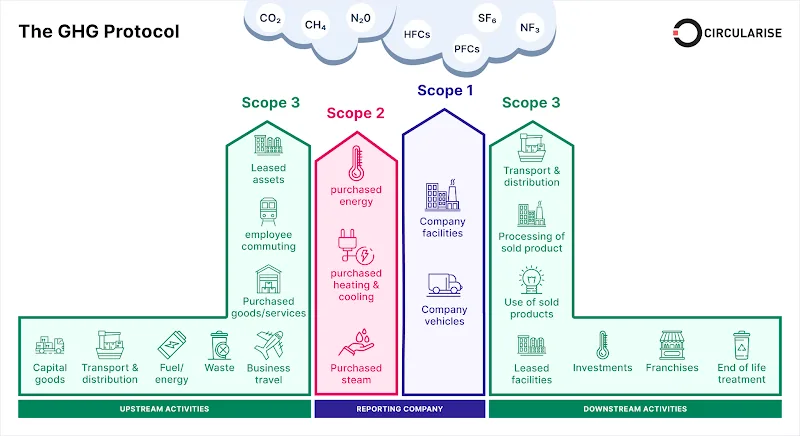
A carbon footprint is split into three categories, scope 1, scope 2 and scope 3, which is a process defined by the Greenhouse Gas Protocol. These categories enable a company to think about emissions that are within their control or associated with their supply chain and stakeholders.
a carbon footprint is measured in a unit of tonnes or kilograms of carbon dioxide equivalent (tCO2e). This means that the unit takes into account not just carbon dioxide, but all greenhouse gas emissions.
Scope 1 and 2: Within the business’s control
This is arguably the most important category, as only you can decarbonise these activities. If every business tackled their scope 1 and 2 activities, we would achieve total decarbonisation.
- Heating of company buildings
- Fuel use for company vehicles
- Electricity usage
- Purchased heating and cooling
- Air conditioning fugitive emissions
The data for each of these areas should be readily available through existing documents like electricity bills, heating utility bills, air conditioning maintenance records (shown as ‘top ups’) and company mileage or fuel card records.
Scope 3: Within the business’s influence
Scope 3 should always be tackled, even though the decarbonisation choices sit with another company’s direct control. In this category you should report on your employees’ commuting and business travel, as well as the emissions associated with capital goods, purchased goods and services, waste, water, investments and more.
Getting under the bonnet of scope 3
Whilst sourcing data for scope 1 and 2 is a simpler task, relying on utility bills and data already captured for financial accounting purposes, scope 3 can be more complex. Some aspects will be easily achievable, for example waste transfer notes from your waste contractor and water bills. However the remaining categories require a greater degree of knowledge and understanding to unpick. This is why it is often advisable to utilise a carbon consultancy to support data gathering and converting the data into carbon metrics.
For many beginning the process, ‘spend based data’ can be used. This means utilising the amount of money spent on any given category, for example expenditure on stationery, staff accommodation or raw materials to produce a product. However this only provides what is known as a ‘screening’ as the price of items varies greatly, and conversion factors to understand the greenhouse gas emissions based on spend will take an average assumption.
The ideal scenario is to achieve ‘activity based data’ for each category within scope 3, which will provide a true picture of the greenhouse gas emissions associated with it.
A company spending £10,000 per year on cleaning services could utilise that spend figure to estimate the likely emissions based on averages.
Preferably, the business would ask the cleaning company for the transport details the cleaning staff utilise to undertake the activity e.g. car, train, or bus and the mileage, distance or fuel use. They may also ask what materials are utilised, e.g. chemicals. These two pieces of information will provide accurate data regarding the greenhouse gas emissions of the specific activity.
How can the data help?
In the example given, a business choosing a local company to clean the offices will have a lower carbon burden than if the cleaning contractor is travelling from further afield. Therefore, whilst the cleaning contractor is responsible for making low carbon travel choices, the business can choose a local supplier to reduce the overall carbon footprint through distance travelled.
Understanding the greenhouse gas emissions associated with your operational activities means that you can take steps to reduce your impact, and potentially save money and build overall sustainability.
Where to get the conversion factors from
The most difficult part of the carbon footprinting process is understanding how to apply the conversion factors, which change your activity unit (for example litres, kWh or miles) into tCO2e or kgCO2e. This is best done through a qualified carbon accountant, however it is possible to attempt carbon footprinting in house, as some conversion factors are available through the government website. The website provides both the conversion factors, and a detailed explanation of how to apply them.
What to do next?
Once you have worked out your carbon footprint, it is time to do something with the figures. The footprint is the map, now you need to know how to get to your destination. A carbon reductions pathway is therefore the sat nav!
Explore more articles
Understand the greenhouse gases and gather the data you need.


Plan, prioritise and track your organisation’s progress.